Roulette Research

Roulette Wheel Anatomy Explained: Every Part, the Number Layout and a Free Roulette Wheel Chart

A casino wheel is a precision instrument about 81 centimetres across. Here it is taken apart: the parts, the number layout and a chart you can use.

Anatomy · Layout · Chart

Roulette Research editorial desk ·

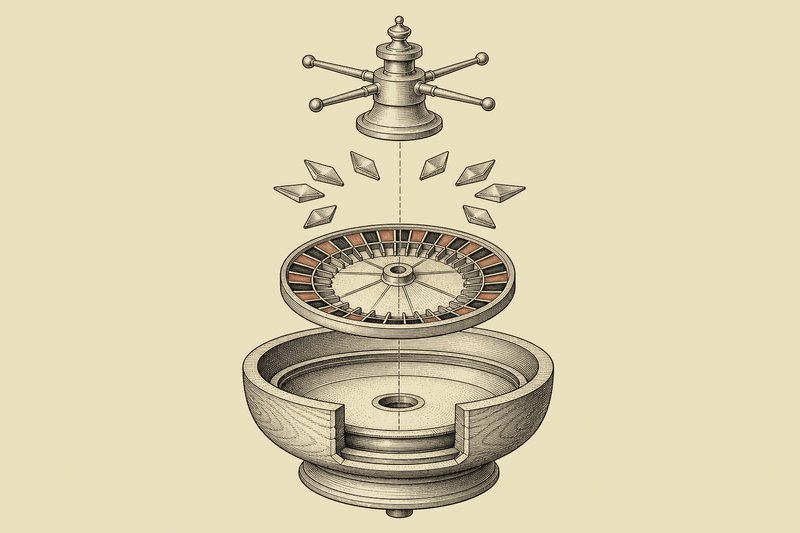
Exploded illustration of a roulette wheel showing the turret, deflectors, rotor and wooden bowl as separate layers
Editorial noteTurret, deflectors, rotor, bowl. Taken apart along one axis, the wheel is six parts and a bearing.

Lift the turret off a casino roulette wheel and the rotor comes up with it, heavy, balanced on a single spindle, and suddenly much less mysterious. The anatomy of a roulette wheel is a handful of parts, each with one job: keep the ball moving long enough, then make where it stops as unpredictable as possible. A roulette wheel chart of both number orders follows further down.

This page walks through the roulette wheel parts from the outside in, explains the roulette wheel layout of the numbers, and ends with a roulette wheel chart for both the single-zero and the double-zero wheel that you can print or embed.

Roulette wheel anatomy: the parts from the bowl to the turret

The bowl and the ball track

The bowl is the fixed body of the wheel, traditionally solid hardwood, set into the table and levelled with care. Its upper rim carries the ball track, a smooth inclined groove where the dealer launches the ball against the direction of the rotor. The ball circles there, pressed outwards by its own speed, until it slows enough to fall.

The apron and the deflectors

Below the track a sloping surface, sometimes called the apron, leads down towards the rotor. Set into it are the deflectors, usually eight metal diamonds alternating between vertical and horizontal orientation. Many balls strike one on the way down, and the collision scatters the ball's path.

The rotor, pockets and frets

The rotor or wheelhead is the part that spins. Around its edge sit the numbered pockets, 37 on a single-zero wheel and 38 on a double-zero wheel, separated by metal dividers called frets or separators. Older wheels had tall frets and deep pockets; many modern wheels use low-profile frets and shallower pockets, so the ball bounces further before it settles.

The turret, spindle and bearing

At the centre the turret, the cross-shaped handle the dealer uses to spin the rotor, sits on a spindle that runs in a precision bearing in the bowl. The rotor has to be balanced and the bearing free, or the wheel develops a tilt or a wobble. Both can create a measurable bias, which is why casinos check level and balance on a schedule.

Roulette wheel parts and their jobs
PartAlso calledWhat it does
Bowlstator, bodyFixed housing, levelled into the table
Ball trackback trackGroove where the ball circles after launch
Deflectorsdiamonds, canoesScatter the falling ball
Rotorwheelhead, cylinderSpinning part carrying pockets and numbers
FretsseparatorsDivide the pockets
Turretspindle handleUsed to spin the rotor

The roulette wheel layout and number chart

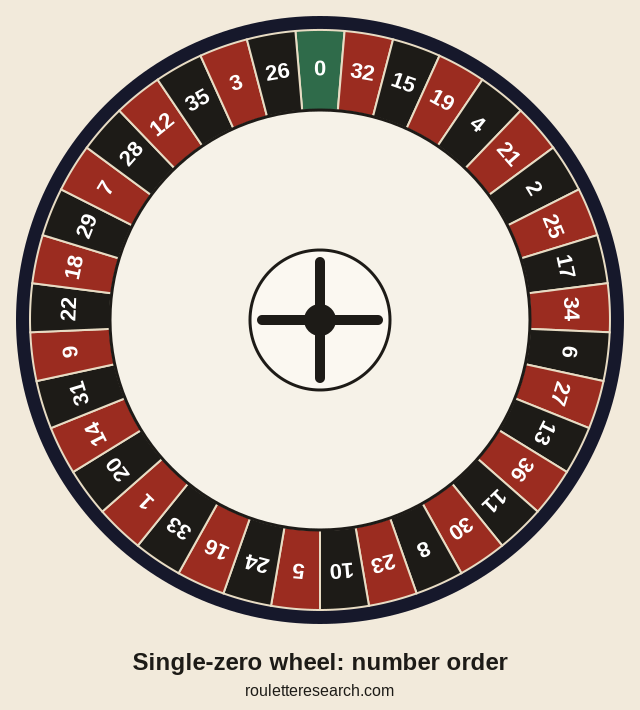
The numbers on the rotor are not in sequence. The roulette wheel numbers order is arranged so that red and black alternate and so that high and low, odd and even numbers are spread around the rotor as evenly as the count allows. On the single-zero wheel the order runs clockwise from zero: 0, 32, 15, 19, 4, 21, 2, 25, 17, 34, 6, 27, 13, 36, 11, 30, 8, 23, 10, 5, 24, 16, 33, 1, 20, 14, 31, 9, 22, 18, 29, 7, 28, 12, 35, 3, 26.

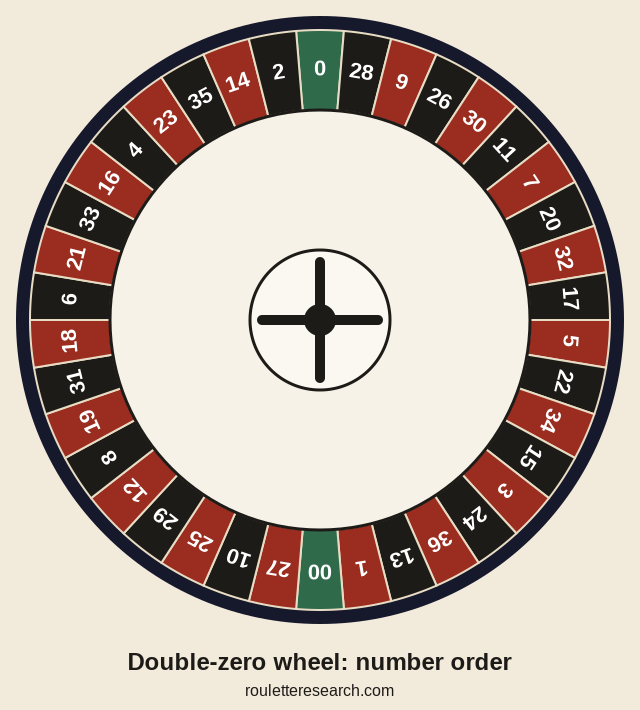
The double-zero wheel uses a different roulette wheel layout. Its 38 pockets put 0 and 00 directly opposite each other, and most consecutive numbers face each other across the rotor, such as 1 and 2, or 13 and 14. Learn one order and you will still be lost on the other wheel, which is a useful thing to know before you try to follow a ball with your eyes.

Single-zero roulette wheel layout showing the order of numbers 0 to 36
Single-zero wheel: the number order clockwise from 0.
Embed this roulette wheel chart
<a href="https://www.rouletteresearch.com/roulette-wheel-anatomy/"><img src="https://www.rouletteresearch.com/embeds/european-roulette-wheel-layout.svg" alt="Single-zero roulette wheel layout showing the order of numbers 0 to 36" width="640" loading="lazy"></a>
<p>Chart: <a href="https://www.rouletteresearch.com/roulette-wheel-anatomy/">Roulette Research</a></p>
Double-zero roulette wheel layout showing the order of numbers including 0 and 00
Double-zero wheel: 0 and 00 sit opposite each other.
Embed this roulette wheel chart
<a href="https://www.rouletteresearch.com/roulette-wheel-anatomy/"><img src="https://www.rouletteresearch.com/embeds/american-roulette-wheel-layout.svg" alt="Double-zero roulette wheel layout showing the order of numbers including 0 and 00" width="640" loading="lazy"></a>
<p>Chart: <a href="https://www.rouletteresearch.com/roulette-wheel-anatomy/">Roulette Research</a></p>

Sections of the wheel: the French call bets

Because the order is fixed, the single-zero wheel can be divided into named sections, and European casinos accept bets on them. Voisins du zéro covers the 17 numbers from 22 to 25 around zero. Tiers du cylindre covers the 12 numbers from 27 to 33 on the opposite side. Orphelins collects the eight numbers left over, in two separate arcs. These are bets on parts of the physical wheel, not of the betting layout, and they have exactly the same house edge as any other combination of numbers.

The table layout and its payouts

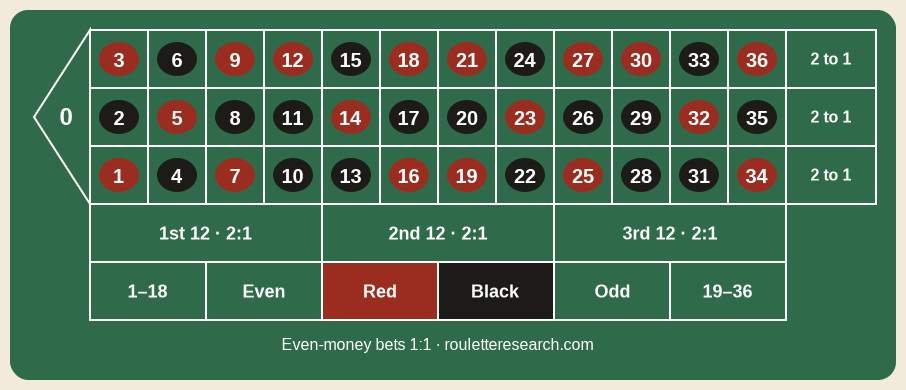
The betting layout on the cloth is a separate thing from the wheel. It arranges the numbers in three columns of twelve, in numerical order, with zero at the head and the outside bets along the edge. The chart below shows the single-zero layout with the standard payouts.

Single-zero roulette table layout with columns, dozens and even-money bets and their payouts
Single-zero betting layout. Embed: <img src="https://www.rouletteresearch.com/embeds/roulette-table-layout-payouts.svg" alt="Roulette table layout with payouts">
Payouts and house edge by wheel
BetNumbersPaysEdge, single zeroEdge, double zero
Straight up135 to 12.70%5.26%
Split217 to 12.70%5.26%
Street311 to 12.70%5.26%
Corner48 to 12.70%5.26%
Six line65 to 12.70%5.26%
Dozen or column122 to 12.70%5.26%
Red, black, odd, even, high, low181 to 12.70%5.26%

The edge comes entirely from the zero pockets: a straight bet pays 35 to 1 on a 1-in-37 chance. Where la partage applies, half of an even-money bet is returned when zero comes up, which halves the edge on those bets to 1.35%. Some casinos have also introduced wheels with a third zero, which raises the edge to about 7.7%.

Size, materials and why the wheel must be level

A casino wheel is usually around 32 inches across, roughly 81 cm, and some models measure 30 inches. Bowls are hardwood or composite, rotors combine wood or composite with machined metal, and the frets and deflectors are metal. Weight and stiffness matter: a heavy, rigid wheel keeps its shape and its level over years of use.

Level matters most of all. Research on roulette physics has shown that even a very small tilt makes the ball leave the track preferentially at one part of the bowl. That is why wheel inspection, levelling and rotor balancing are routine, and why a ball that always seems to drop at the same spot is worth a technician's look. The ball itself is the other half of the system; see the guide to roulette balls, and the history of the roulette wheel for how these parts evolved.

You can watch that order at work in the roulette simulator, which uses the same wheel sequence to show where the hits fall around the rotor. And if you ever see a wheel with the turret removed, look at the underside of the rotor: the balancing weights a technician adds are often still there, small and unremarkable, holding the whole thing true.

Frequently asked questions

What are the parts of a roulette wheel called?

The main roulette wheel parts are the bowl (the fixed outer body) with its ball track, the deflectors set into the sloping apron, the rotor or wheelhead that spins, the pockets and the frets that separate them, the number ring, and the central turret with its spindle and bearing.

What is the number order on a single-zero roulette wheel?

Clockwise from zero: 0, 32, 15, 19, 4, 21, 2, 25, 17, 34, 6, 27, 13, 36, 11, 30, 8, 23, 10, 5, 24, 16, 33, 1, 20, 14, 31, 9, 22, 18, 29, 7, 28, 12, 35, 3, 26. The roulette wheel numbers order alternates red and black and spreads high, low, odd and even numbers around the rotor.

How is the double-zero wheel layout different?

The double-zero roulette wheel layout has 38 pockets, with 0 and 00 placed directly opposite each other. Most consecutive numbers also sit opposite each other, for example 1 and 2, or 13 and 14, which gives it a different pattern from the single-zero wheel.

How big is a casino roulette wheel?

Casino wheels are usually about 32 inches (around 81 cm) across, with some 30-inch models. Smaller wheels are made for home use and tabletop games.

What do the diamonds on a roulette wheel do?

The diamonds are deflectors. They stand on the sloping apron between the ball track and the rotor, and the falling ball often strikes one of them, which adds randomness to where it lands. Most casino wheels have eight, alternating in orientation.

Can I use the roulette wheel chart on my own site?

Yes. The wheel charts and the table layout on this page can be embedded with the snippet under each image, which links back to this page as the source.

Why are the numbers not in order on the wheel?

The arrangement spreads the colours, odd and even numbers and high and low numbers as evenly as possible around the rotor, so that no section of the wheel favours one outside bet.

Sources