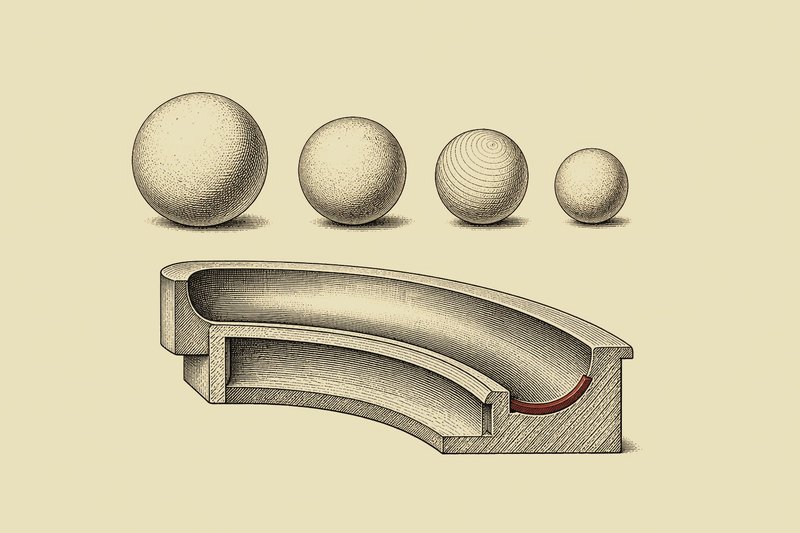
Pick up roulette balls from three different casinos and you would notice the difference before you looked at them. One feels heavy for its size, another clicks against your ring like a billiard ball, a third is so smooth it almost slides out of your fingers. The materials, size and weight of roulette balls vary more than most players assume, and each of those three properties changes how the ball runs on the wheel.
None of it changes the probability of a number. On a level, true-running wheel each pocket keeps its 1-in-37 chance (1 in 38 on a double-zero wheel), whatever the ball. What does change is the path: how long the ball stays on the track, how it meets the deflectors, how far it bounces across the rotor before it stops. That is why casinos keep several balls per table and why anyone who has studied roulette as a physical system pays attention to them.
Roulette ball materials, from ivory to engineering plastic
For most of the game's history the ball was ivory. It was hard, it could be turned on a lathe to a good sphere, and it was what billiard balls and dice were made of too. An ivory roulette ball was never perfectly uniform, though. Tusk ivory has growth layers and a slight grain, so two balls cut from different pieces could differ in density and in how they rebounded.
Cast phenolic resin, the material family that includes Bakelite, replaced ivory in the decades after the First World War. Today the common roulette ball materials are engineering plastics: acetal (polyoxymethylene, sold under names such as Delrin), PTFE (polytetrafluoroethylene, known as Teflon), nylon and phenolic resin. Each comes with its own density, hardness and surface friction.