Roulette Research

Casino Chips Through History: Materials, Makers and a Practical Guide to Telling Them Apart

Long before anyone printed a value on them, gaming counters were carved from shell. The materials of casino chips trace three centuries of games, plastics and security.

History · Materials · Guide

Roulette Research editorial desk ·

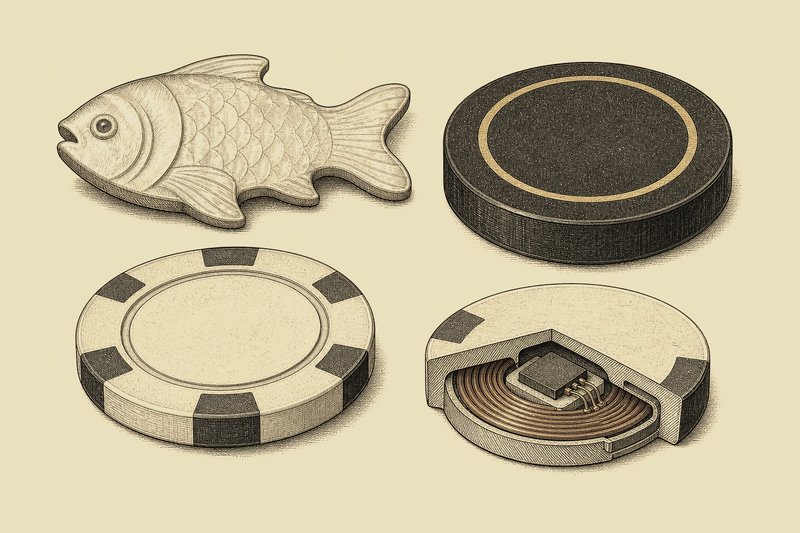
Illustration of a mother-of-pearl fish counter, a marbled Catalin chip, two clay chips and a chip with an embedded circuit
Editorial noteShell, resin, clay composite, embedded coil: three centuries of making a promise hard to copy.

A casino chip is a promise in physical form: the casino says this disc is worth a fixed sum, and only on its premises. The history of casino chips is the history of making that promise hard to copy. The materials changed from shell and bone to resin, clay composites and embedded electronics, and each change answered a problem of the one before.

This guide follows that line through the objects themselves, from mother of pearl casino chips that were never used in a casino to the tagged composites of today. It is written for anyone who has picked up an old chip and wondered what it is made of, and for collectors who want to place vintage casino chips by material and period.

The history of casino chips begins before casinos

The ancestors of casino chips were counters for card games played at home. In 18th- and 19th-century Europe, wealthy households kept sets of carved counters for games such as loo and quadrille. The most prized were mother-of-pearl counters made in Canton (Guangzhou) for export: thin pieces of shell cut into fish, rectangles and discs, engraved with patterns and often with the family's monogram or crest.

Mother of pearl casino chips, as dealers now often call them, were therefore rarely casino chips at all. They were domestic objects, and their value lay in the craftsmanship. Bone and ivory counters, stamped metal tokens and painted wood served the same purpose lower down the price scale.

Mother-of-pearl counter

Hand-cut and engraved shell counters, often fish-shaped, ordered by European families for card games such as loo and quadrille.

Material: nacre (shell)Period: 18th–19th centuryMade in: Canton, for export

Catalin chip

Bright, glossy and heavy in the hand. Cast resin with no filler, so it took colours Bakelite never could.

Material: cast phenolic resinPeriod: 1930s–1940sLook: translucent, marbled, inlaid

Clay composite chip

The classic casino chip. Pressed under heat from a clay-based mix, with edge spots formed in the same mould.

Material: compression-moulded clay mixDiameter: 39 mm (common)Mass: about 9–10 g

RFID chip

An antenna and a tiny transponder sealed inside the chip. A reader under the felt can identify each one.

Material: composite with embedded tagPeriod: 2000s onwardFeature: serial readable at the table

Casino chip materials in the 20th century: Catalin, Bakelite and Plaskon

The arrival of synthetic resins changed what a gaming chip could look like. Bakelite, patented by Leo Baekeland in 1907, was the first fully synthetic plastic, but its fillers made it dark and opaque. In the 1930s cast phenolic resins sold under the name Catalin removed the filler and with it the limits on colour. Catalin poker chips came in butterscotch, cherry red, green and marbled mixes, sometimes with inlaid rings or contrasting centres.

Catalin poker chips are now among the most collected of all chips. They are heavy, they ring when dropped on each other, and they slowly yellow with age, which is why a once-white Catalin chip often looks cream today. Plaskon, a moulded urea-formaldehyde plastic of the same decade, was used for some chips and many household objects. It is lighter and more matte than Catalin.

Clay vs plastic casino chips: what casinos use today

Commercial casinos settled on compression-moulded chips. What the trade calls clay is a composite of clay and other minerals pressed under heat, with the coloured edge spots formed in the same mould. A typical casino chip measures 39 mm across and weighs around 9 to 10 grams. Many now carry a printed inlay or a ceramic layer on the faces for artwork, while the edge stays composite.

The clay vs plastic casino chips question matters most to home players. Injection-moulded ABS plastic chips are cheap and durable, and many have a metal slug inside to add weight. Composite chips feel softer, stack more quietly and take finer edge detail, which is why casinos pay several times more for them. A small number of large manufacturers supply most casinos; Gaming Partners International, formed in 2002 when the US company Paul-Son Gaming merged with France's Bourgogne et Grasset, is one of the best known.

Casino chip materials at a glance
MaterialPeriodHow to recognise it
Mother-of-pearl18th–19th c.Iridescent shell, hand engraving, thin and light
Bone and ivory19th c.Grain or growth lines, slight irregularity
Bakelitefrom c. 1910sOpaque, dark, heavy, faint smell when warmed
Catalin1930s–1940sTranslucent or marbled, bright colours, yellows with age
Clay composite20th c. to todayMatte, slightly soft, edge spots moulded in
ABS plasticlate 20th c. to todayGlossy, hard, seam line, often a metal insert
RFID composite2000s onwardLooks like a casino chip; tag only visible in X-ray or cut section

Roulette chips: the colour is the bet

Roulette uses chips in a way no other casino game does. At many tables each player buys in for a stack in a single colour, with no value printed on it. The dealer records what one chip is worth for that player, often by placing a marker on the wheel's rim or a chip on the colour stack. The colour then tells the dealer, at a glance, whose bet is whose when several players have stacked on the same number.

Those chips are worthless away from the table and are cashed in for value chips before a player leaves. If you have ever found an unmarked chip in a coat pocket after a casino visit, that is what it is.

Security: from edge spots to RFID

Every generation of chip design added something a counterfeiter has to copy: a unique mould pattern, coloured inserts in the edge, a hot-stamped or printed inlay, ultraviolet marks visible only under a lamp. Radio-frequency identification (RFID) went further. A tag sealed in the chip carries a serial number that a reader built into the table can check, so a casino can tell genuine chips from copies and track chip movements across tables.

RFID also makes it practical to cancel chips. If a series of chips is stolen, the casino can declare those serials void and refuse to redeem them.

A short guide to identifying vintage casino chips

Start with the material: weight in the hand, sound when two chips touch, translucency against a light. Then look at the mould: the pattern on the faces and the edge is specific to a manufacturer and often to a period. The name of the casino, its city and any denomination narrow the date further, and collectors' clubs keep catalogues of known issues.

Two things to be careful about. Catalin and Bakelite are reproduced, so a perfectly white or perfectly clear old-looking chip deserves suspicion. And chips from closed casinos are legally just collectibles; whether a casino still honours older issues is entirely its decision. For the other hardware at a roulette table, see the guides to roulette balls and to the anatomy of the roulette wheel.

One curiosity to end on: the yellowing of Catalin is so reliable that collectors sometimes judge the age of a chip by the depth of cream on its surface, and a chip that was kept in a drawer can look decades younger than its twin left in the sun.

Frequently asked questions

What are casino chips made of?

Most casino chips are compression-moulded from a clay-based composite, sometimes with a ceramic or plastic layer for printed artwork. Cheaper home sets are injection-moulded ABS plastic, often with a metal insert for weight. Historic gaming counters were made of mother-of-pearl, bone, ivory and, in the 1930s, Catalin resin.

Are clay casino chips really made of clay?

Not pure clay. The chips sold as clay are a composite of clay with other minerals and binders, pressed under heat and pressure. Pure clay would be too brittle for a casino floor. The clay vs plastic casino chips difference is mainly feel, sound and edge detail: composites are softer and quieter when stacked.

How can you tell Catalin poker chips from Bakelite?

Catalin poker chips are usually translucent or marbled and come in bright colours: butterscotch, cherry red, green. Bakelite, an earlier phenolic, is opaque and typically dark brown or black because of its fillers. Both are heavy for their size and give off a faint chemical smell when rubbed warm.

Why do roulette tables use chips without a value printed on them?

At many roulette tables each player buys in for a set of chips in one colour, and the dealer records what each chip is worth for that player. The colour tells the dealer whose bet is whose on a crowded layout. The chips have no value away from that table and must be exchanged before leaving it.

Are mother of pearl casino chips valuable?

Engraved mother-of-pearl gaming counters from the 18th and 19th centuries are collected and sell at auction, with prices depending on the carving, the condition and whether they carry a family monogram or crest. Most were made for card games at home rather than for casinos.

How do casinos stop chips from being counterfeited?

Each casino uses its own mould and colour pattern, edge inserts, ultraviolet marks and, in many venues, RFID tags. A tagged chip can be checked by a reader under the table, and a series of chips can be declared void after a theft.

What do vintage casino chips tell a collector?

The mould pattern, the edge inserts, the hot stamp or inlay and the name of the casino date a chip quite closely. Vintage casino chips from closed venues are a large collecting field, and clubs keep catalogues of known issues.

Sources