Roulette Research

Roulette Simulator and Wheel Lab: Spin, Read the Statistics and Run a Chi-Square Bias Test

Spin a single- or double-zero wheel up to a million times, paste results from a real table, and see what a fair wheel looks like in numbers.

Wheel · Statistics · Chi-square

Roulette Research editorial desk ·

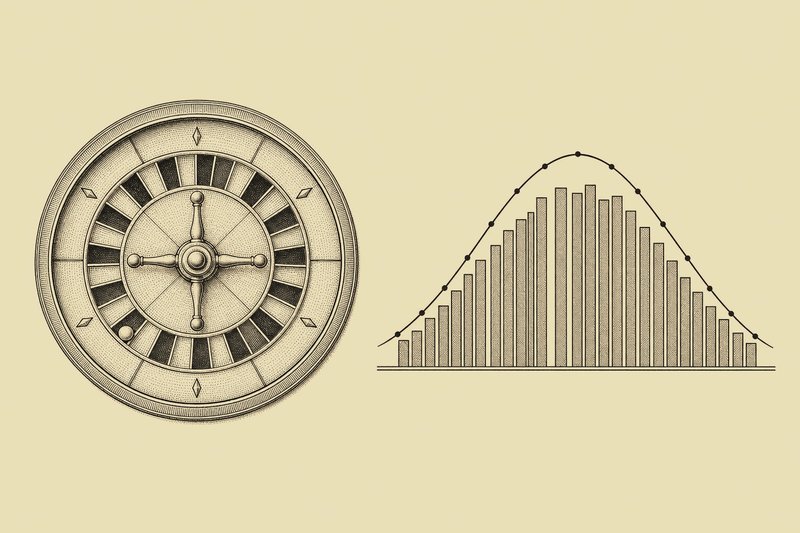
Engraving of a roulette wheel beside a printed bar chart of spin results
Editorial noteA fair wheel in numbers: the bars never come out level, and that is exactly what fairness looks like.

The Lab / Roulette simulator

Wheel
Weight one pocket (test a biased wheel)

Spins: 0

Share of spins per pocket, in wheel order (%). Dashed line: what a fair wheel expects.

Chi-square
–
Degrees of freedom
–
p-value
–

Spin by hand

Test your own results

Spins needed to detect a bias

About – spins (5% significance, 80% power).

The roulette simulator above does one thing a casino table cannot: it shows you what thousands of spins of a fair wheel look like, in seconds, and how the numbers behave as the sample grows. It is an online roulette wheel simulator built for looking at roulette statistics, not for practising bets, and unlike most roulette wheel simulator pages it lets you test results of your own.

Start with 1,000 spins and the bars look ragged, with some pockets far above the dashed line and some far below. Switch to 1,000,000 and the same chart flattens almost completely. Nothing about the wheel changed between the two runs. Only the sample size did, and that is the first thing the roulette simulator is good for.

How the roulette wheel simulator works

Every run draws a number from a seeded pseudo-random generator for each spin and maps it to one of the 37 or 38 pockets, each with equal weight. The seed is stored in the page address, so the copy-link button reproduces the run exactly: same seed, same spins, same chart. A new run picks a fresh seed from the browser's cryptographic random source. The single spins on the animated wheel use that source directly.

The chart lists the pockets in the order they sit on the rotor, not in numerical order, the same sequence shown in the anatomy of the roulette wheel. That makes a cluster on one sector of the wheel easy to see, and a cluster on the wheel is what a physical fault would produce.

Reading the roulette statistics

On a single-zero wheel each pocket expects 1/37 of the spins, about 2.70%. Red and black each expect 18/37, about 48.65%, and zero 2.70%. On a double-zero wheel the figures are 1/38 per pocket, 47.37% for each colour and 5.26% for the two zeros together. The red, black and zero shares in the readout settle on those values as the spins pile up.

What does not settle is the raw difference. In 10,000 spins a single pocket expects about 270 hits, and anything from roughly 240 to 300 is unremarkable. The gap between the most and least frequent pocket in a run is therefore large in absolute terms even when the wheel is perfectly fair. Roulette statistics only start to say something when you compare that spread with what chance alone produces, which is what the next test does.

The chi-square test, explained without the jargon

The chi-square statistic takes each pocket, squares the difference between its count and the expected count, divides by the expected count and adds the results. A fair wheel gives a total near the number of degrees of freedom, 36 for a single-zero wheel and 37 for a double-zero wheel. The p-value is the share of fair-wheel runs that would produce a total at least as large as the one observed.

A p-value of 0.4 means four in ten fair wheels would look at least this uneven: nothing to see. A p-value below 0.05 happens one time in twenty on a fair wheel, which is why a single small value is a reason to collect more spins, not a verdict. Try it: run the fair wheel several times and you will see an occasional p-value under 0.05 with no bias at all.

≈ 23,000

Spins needed to have an 80% chance of detecting a pocket that comes up 10% more often than a fair wheel allows, testing at the 5% level. A casino table running 40 spins an hour would need about three months of continuous play to collect them.

How many spins it takes to find a biased wheel

Weight one pocket in the simulator and watch how long it takes the test to notice. The table gives the sample sizes for a one-sided test on a single pocket, at 5% significance and 80% power, computed with the normal approximation used by the calculator above.

Spins needed to detect one over-weighted pocket
Extra weight on the pocketSingle zero (37)Double zero (38)
+5%90,48292,997
+10%22,97723,616
+20%5,9186,083
+30%2,7052,780
+50%1,0251,054

Real wheel defects, when they exist, tend to affect a sector rather than one pocket, and a test on the whole distribution such as chi-square is the standard first check. It also has to contend with the fact that casinos rotate balls, rebalance rotors and move wheels between tables, so the wheel at the end of a long sample is not always the wheel at its start. The physics behind those defects is covered in roulette prediction: fact or fiction.

Roulette wheel analysis in practice

Casinos run their own roulette wheel analysis. Table systems log every winning number, and the same kind of test runs on those records to flag a wheel that drifts from the expected distribution. A flagged wheel is checked for level, a worn bearing, a loose fret or a damaged ball, and serviced. That routine is the reason the classic story of the biased wheel belongs mostly to the past.

If you have a log from a physical wheel, paste it into the box in the lab; the online roulette wheel simulator reads plain lists of numbers. Expect the honest answer most of the time: no evidence of bias. That is also what a careful roulette wheel analysis in a casino finds on a well-maintained wheel, and it is the outcome the roulette simulator reproduces every time you run the fair wheel.

About these figures

The simulator draws each spin from a 32-bit seeded generator (mulberry32) with equal weights for the 37 or 38 pockets, or with one pocket weighted by the percentage you set. The chi-square p-value is computed in the browser from the regularised incomplete gamma function with 36 or 37 degrees of freedom. The sample sizes in the table come from the normal approximation for a one-sided test of one proportion, z = 1.645 and 0.842. A simulation shows how a fair or deliberately weighted wheel behaves; it cannot model the physics of a real ball and rotor. Figures as of September 2026, checked against the same formulas in the calculator on this page.

Frequently asked questions

Is this roulette simulator random?

Each simulated run uses a seeded pseudo-random generator, so a shared link reproduces exactly the same spins, while a new run draws a fresh seed from your browser's cryptographic random source. Single spins by hand use that cryptographic source directly. Every pocket has the same weight unless you choose to weight one.

What does the chi-square test in the roulette wheel simulator measure?

It adds up how far each pocket's count is from the count a fair wheel would give, scaled by that expected count. The p-value then says how often a fair wheel would produce a total at least that large. A small p-value means the counts are hard to explain by chance alone.

How many spins do I need to test a real wheel?

More than most people expect. To have a good chance of detecting a pocket that comes up 20% more often than it should, you need around 6,000 spins; for a 10% bias, around 23,000. Use the calculator on this page for other sizes of bias.

Can roulette statistics from an online casino be tested here?

You can paste any list of results into the analysis box. For online games run by a certified random number generator the test will almost always show nothing, which is the expected outcome; it is most useful as a check on a physical wheel or on a recorded live-dealer table.

Can I analyse a session I tracked at a roulette table?

Yes. Paste the numbers you tracked, separated by spaces, commas or new lines, and the chi-square test shows whether their counts stray further from a fair wheel than chance allows. With a few hundred spins that is rarely the case; the calculator on this page shows how many spins a real bias would need before it stands out.

Why do some numbers come up much more often in a short session?

Because variance is large compared with the expected count when the sample is small. In 370 spins a pocket expects 10 hits, and anything from about 4 to 16 is normal. Those swings shrink in proportion as the number of spins grows, which you can watch by switching from 1,000 to 1,000,000 spins.

Does this online roulette wheel simulator help to win at roulette?

No. It shows how a fair wheel behaves and how hard it is to tell a slightly unfair one apart from a fair one. No betting pattern changes the house edge of 2.70% on a single-zero wheel or 5.26% on a double-zero wheel.

What is roulette wheel analysis in a casino?

Casinos and wheel makers record results from their tables and run statistical checks like the one here to spot a wheel that has drifted out of true, for example through wear, a loose fret or a tilt. A flagged wheel is inspected and serviced.